
|
The Mathematical Association of America Maryland-District of Columbia-Virginia Section |
- Home
- History
- Main History Page
- Section History Document
- List of Past Officers
- Charter Members
- African-American Participation
- Stories from Section Members
- Section NExT Fellows
- Obituaries
- Smith Award Recipients
- Christensen Award Recipients
- Meritorious Service Award Recipients
- Undergraduate Award Winners
- Meeting Archive
- Past Meetings
- Talk Archive
- Old Section NExT Programs
- Newsletter Archive
- Meeting Minutes Archive
- Miscellaneous Documents
- Meetings
- Minutes
- Spring 2026 Executive
- Spring 2026 Membership
- Fall 2025 Executive
- Fall 2025 Membership
- Spring 2025 Executive
- Spring 2025 Membership
- Fall 2024 Executive
- Fall 2024 Membership
- Spring 2024 Membership
- Fall 2023 Executive
- Fall 2023 Membership
- Spring 2023 Executive
- Spring 2023 Membership
- Fall 2022 Executive
- Fall 2022 Membership
- Spring 2022 Executive
- Spring 2022 Membership
- Fall 2021 Executive
- Fall 2021 Membership
- Spring 2021 Executive
- Spring 2021 Membership
- Fall 2020 Executive
- Fall 2020 Membership
- Fall 2019 Executive
- Fall 2019 Membership
- Spring 2019 Executive
- Spring 2019 Membership
- Fall 2018 Executive
- Fall 2018 Membership
- Spring 2018 Executive
- Spring 2018 Membership
- Minutes Archive
- Newsletters
- Section NExT
- Awards
- Students
- Links
- Search
Spring 2026 Meeting at Frederick Community College
Conference Links

Geoff CoxVirginia Military InstituteFriday workshop: Getting Started with PreTeXt for Accessible, Interactive Course Materials Abstract: PreTeXt is an open-source authoring system designed for creating high-quality mathematical and STEM materials in multiple formats (including web and PDF) from a single source. In this beginner-friendly, hands-on workshop, participants will learn what PreTeXt is, how a typical authoring workflow is organized, and how to get from “first file” to published output quickly. We'll walk through the basic structure of a PreTeXt project. Attendees will leave with a clear setup path, a minimal working example they can adapt for their own courses, and a roadmap for adding interactive elements, managing larger projects, and collaborating on open textbooks. No prior PreTeXt experience is assumed. Biographical Sketch:
Applied mathematician and educator, Geoff Cox, is an Associate Professor in the Department of Applied Mathematics at Virginia Military Institute. His recent work centers on developing open, interactive online textbooks. Using the PreTeXt authoring workflow, he creates web-first texts that integrate interactive components and modern publishing formats, supporting both student engagement and long-term sustainability of instructional resources. 
C. Allen ButlerDaniel H. Wagner Associates, Inc.Banquet Address: Bayes' Theorem – Making Rational Decisions in the Face of Uncertainty Abstract: A statement of Bayes' Theorem (aka Bayes' Rule) can be written very succinctly, but this belies its far-reaching consequences. In this talk, I will provide a little of the history behind Bayes' Theorem, a derivation of the mathematical basis in probabilistic terms, and a description of the less formal basis where it is viewed as a form of evidential or inferential reasoning. I will illustrate the utility of Bayes' Theorem by describing applications from the work of my company, Daniel H. Wagner Associates, Inc. One of these resulted in the location and recovery of the “Ship of Gold,” the SS Central America, a side-wheel steamer carrying nearly six hundred passengers returning from the California Gold Rush, which sank in a hurricane two hundred miles off the Carolina coast in September 1857. Biographical Sketch: Dr. Butler holds a B.A. in Mathematics from Texas Tech University and a PhD in Mathematics from the University of Illinois, Champaign-Urbana (1987). He has been employed at Daniel H. Wagner Associates, Inc. (www.wagner.com) since 1987, serving as President and CEO from 2008 to 2021. Throughout his career, Dr. Butler served as the principal investigator for Department of Defense R&D projects involving a variety of mathematical disciplines as applied to areas such as target tracking, multi-sensor data fusion, and search optimization. He has been involved in the development and implementation of optimal search techniques for a number of projects, including a research effort whose goal was the interdiction of narcotics smugglers in the Caribbean. Dr. Butler is a member of AMS, MAA, SIAM, IEEE, INFORMS, and a number of industry specific professional organizations. Dr. Butler is an INFORMS Fellow, former Treasurer of the MAA, and serves on the INFORMS Prize Committee for the “Daniel H. Wagner Prize for Excellence in Analytics and Operations Research Practice.” He also serves on the Board of Trustees of the Institute for Mathematical and Statistical Innovation (IMSI) and on the Board of Directors of the Consortium for Mathematics and its Applications (COMAP). 
Opel JonesJohn's Hopkins University Applied Physics LaboratorySaturday Morning Address: Pattern Avoidance in Restricted Permutations Abstract: In 1974 Dumont found two types of permutations are counted by the same sequence. The first type is a permutation in which each even entry is followed by a smaller entry, and each odd entry is followed by a larger entry, or ends the permutation. The second type is a permutation wherein if an entry is a deficiency, it must be even, and if an entry is an exceedance or a fixed point, it must be odd. These are now known as Dumont permutations of the first and second kinds. There are two other types of permutations which are also counted by the same sequence, known as Dumont permutations of the third and fourth kinds. In this talk we will discuss several enumerations of restricted Dumont permutations, that is Dumont permutations avoiding certain patterns. We will also briefly discuss their proofs which involve methods using induction, block decomposition, Dyck paths, and generating functions. We will conclude with a conjecture that the patterns 2143 and 3421 are indeed Wilf-equivalent on Dumont permutations of the first kind. Biographical Sketch:
Opel is a loving husband, dedicated father, and servant to the community. He mentors, tutors, volunteers in his free time through his fraternity, and coaches youth football and youth baseball. Throughout the years, Opel has worked as an engineer, mathematics and statistics lecturer, development officer, and computer scientist, at several institutions and the federal government. He also served as Director of the Leadership Institute for several years at Hampton University, teaching leadership studies and developing leaders in addition to teaching mathematics and honors seminars. Currently, he is a mathematician and analyst at The John's Hopkins University Applied Physics Laboratory. Additionally, he is currently serving on the County Council in Howard County, Maryland. He was first elected to office in 2018, and just re-elected in 2022. 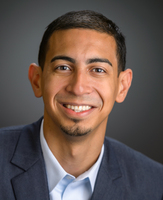
Alexander Diaz-LopezVillanova UniversitySaturday Afternoon Address: AI Is Changing Our Profession: What Do We Do? Abstract: Generative AI is already changing mathematics education and, more broadly, our profession. Whether we welcome it, resist it, or remain unsure, these tools are influencing teaching, assessment, student learning, and even mathematical research. This talk will explore how AI is reshaping the landscape of our field and profession, highlight emerging developments, and invite us to think carefully about how we should respond. Biographical Sketch: Alexander Diaz-Lopez is a mathematician, educator, and community builder who currently serves as Associate Professor of Mathematics and Statistics at Villanova University. His research in combinatorics and algebraic graph theory is currently supported by the NSF. He is passionate about creating inclusive mathematical communities and mentoring students through collaborative research experiences and innovative teaching. Recently, he has explored the role of generative AI in mathematics education. Alexander loves the MAA, is part of the editorial board at Mathematics Magazine, Member-at-Large of the MAA EPaDel section, and was the recipient of the 2021 MAA Henry Alder Award for Distinguished Teaching |
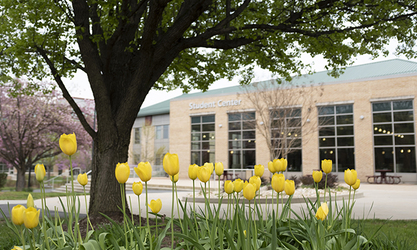 The Spring 2026 Meeting of the MD-DC-VA section of the MAA
was held at
The Spring 2026 Meeting of the MD-DC-VA section of the MAA
was held at Copyright © 2026 - The Mathematical Association of America
Please send comments, suggestions, or corrections for this page to Brian Heinold at heinold@msmary.edu
Last Modified: 07/05/2026 - 05:59pm