|
| ||||
|
Chairperson's Report | ||||
|
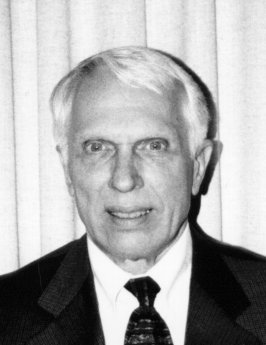
I attended a recent departmental committee meeting (so what's new?) and was confronted by the astonishing fact that the last two years have witnessed a dramatic decline in the number of undergraduate mathematics majors. While this was of particular concern in my own department, I discovered shortly afterwards that this is a problem across the State of Michigan, and indeed, nationwide. |
| |||
|
Why is this happening? We are constantly reminded that mathematics is a key player in the technologically based future, that the "worker" of the future must have at least some mathematics proficiency, and that as a nation we are in jeopardy because the performance of our K12 students in mathematics and science lags far behind that of economically competing nations. This would seem to point to the need for an increase in the number of university students majoring in mathematics. As a mathematical community, we should seriously begin to analyze why increased demand for mathematics is not translating into more majors in mathematics. There are two broad areas where we can at least begin to ask some relevant questions. (1) Is the mathematics we teach the mathematics the outside world wants and needs? Lots of tensions are centered around this point. Technology has definitely changed the way mathematics is used. In the face of this, what should be taught? Should we teach students to use the technology? Should we use the technology to bypass symbol manipulation in favor of concepts? I have no answers here, but these are points we should all actively consider. (2) Are we doing an adequate job with career counseling? We are frequently asked (by good students) exactly what the career opportunities are for a bachelors (or masters) degree in mathematics. Are we able to answer? Do we know? I suspect we fare very poorly on this front. Given this, what's to be done about it? It would likely serve us well to take the issue of careers much more seriously. Initiation of data | ||||
|
| ||||
|
bases indicating which careers are taken up by mathematics majors would be a good start (the AMS does a good job of this at the PhD level and organizations such as the Young Mathematicians Network have helped considerably). Forums on career opportunities at professional meetings should perhaps begin receiving much more attention. The point here is not to exhaust all of the issues, but to highlight a serious professional concern. We should not be having these problems convincing students that mathematics is a vibrant and exciting subject that will serve them well throughout their lives. Richard Phillips, Chair | ||||
|
Electronic Service Officer's Report | ||||
|
Math Awareness Week is April 2026, and its topic is "Mathematics and the Internet". A link to the national Mathematics Awareness Week activities is on the Michigan Section home page (http://archives.math.utk.edu/~efife/MAA/). Read the theme essay, browse links related to Math Awareness Week, and view posters which depict world-wide Internet activity over a two-hour period. When you receive this Newsletter, |
| |||
|
if your department has a web page, please check to see that it is included (and correct) in the Section's home page under the heading "Institutions in the Michigan Section". Also, if your department has set up a topical page which would be of interest to the Michigan Section, contact me so that I can establish a link to it. By the time you receive this Newsletter, both the Newsletter and the spring meeting information and schedule should be up on the section page. Let me know of other items that you feel should be accessible online. I can be reached by email at fife@calvin.edu. Earl D. Fife, Public Information Officer | ||||
|
| ||||
|
Secretary and Treasurer's Report | ||||
|
The Michigan Section's current bank balance is $5,338.80. Although this balance is significantly lower than it was at the same time last year, it is not a cause for immediate concern (the Executive Committee will be asking for a dues increasethe first since 1989at the annual meeting, however). Of greater concern is the low response to our annual request for membership dues. (Many thanks to those who have sent in their dues! The lists of institutional members |
| |||
|
and sustaining individual members are shown on pages 22 and 24.) Here, for comparison, are the figures as of March 1 and a similar point last year: March 1997 March 1996 regular members 122 163 sustaining members 54 68 institutional members 26 30 This drop in membership is troubling because we depend on active members to keep the Section vibrant. We exist to serve the mathematics community in Michigan; we cannot succeed without that community's involvement and support. If you have not sent your membership dues for 199697, you can still do so. Please fill out the membership form on page 28 of this Newsletter and send it and your check to me. If you cannot remember whether or not you have paid your 199697 dues, I will be happy to let you know by e-mail (mth_warren@online.emich.edu), phone (313-487-0121), or (slowly) mail. Mathematics departments can send institutional dues to me as well, at the address on the dues form. Institutional dues are $30 for a small institution and $50 for a large institution.
This year we asked that you provide some demographic informa | ||||
|
| ||
|
tion on your dues form. From the responses so far, among our members we have: 3 undergraduate students, 6 graduate students, 14 K12 teaches and administrators, 123 faculty and administrators in higher education, 9 who work in industry, 18 who are retired, and 1 in the military. Thanks to all who responded. On the institutional membership side, our members include 11 private colleges and universities, 9 state colleges and universities and 6 two-year colleges. Bette L. Warren, Secretary/Treasurer | ||
|
High School Visiting Lecture Program Report Several years ago the Michigan Section of the MAA established the High School Visiting Lecture Program (HSVLP). This year 21 speakers have volunteered and over 20 talks have been given so far. In addition to sharing the speaker's interest in mathematics, these visits provide exposure for his or her institution and department. Popular subjects include applications, extensions of high school topics such as non-Euclidean geometry, fractals or spherical trigonometry, and careers in mathematics. Recreational talks are often requested as well. Teachers request speakers from the list of volunteers and their talks. When filling requests we try to limit trips to 50 miles one way (travel is reimbursed) and to assign only one or two talks per year per person. These guidelines necessitate having multiple speakers and repeated topics in each region of the state. If you have a presentation appropriate for high school students, or would like more information, please contact me at Saginaw Valley State University (glj@tardis.svsu.edu; 571-790-5688). As I complete my third year as the director, I want to thank the many volunteers for their willing participation. Next year Mike Gilbert (SVSU) will oversee the program. Garry Johns, HSVLP Director | ||
|
| ||||
|
Governor's Report | ||||
|
I want to give a word of appreciation to Tom Miles, Dick Phillips, Matthew Wyneken, Jim Chesla, and Bette Warren, who have served faithfully as our officers on the Executive Committee of the Michigan Section this year. Jerry Grossman is doing a marvelous job as Newsletter Editor. Grand Valley State University has hosted the MMPC for the past three years, with first Steve Schlicker and then Karen Novotny serving as Director. Earl Fife continues |
| |||
|
to serve as our Webmaster and Public Information Officer. This is just the beginning. The members of the MMPC Exam Committee and the various other committees in the Section continue to make invaluable contributions. The fact is, the success of the programs and activities of the Michigan Section is very dependent on the hard work of many loyal MAA members. I close this remark with a word of appreciation for another very special friend, J. Sutherland Frame, Professor Emeritus from Michigan State University, who died at age 89 on February 27. For many of us, he was Mr. Michigan Section and Mr. Pi Mu Epsilon. We are all saddened to learn of the death of this dear friend, colleague, and renowned scholar. At the national level, MAA has recently undergone major reorganization, which has resulted in operating deficits over the past two years. The Board of Governors is in the process of approving a budget which should bring expenditures back in line with revenues. Dues will increase 3% next year. The MAA needs and deserves your support. Renew your MAA membership, both in the national MAA and in the Michigan Section (see forms on pages 32 and 28). Enlist colleagues and students in your department to do the same. Be sure that your department is an institutional member at both the national and the state level. Finally, don't forget to attend MathFest '97 in Atlanta on August 24. John W. Petro, Governor, Michigan SectionMAA | ||||
Next Newsletter Highlight: Don Lick Honored
Back to Newsletter Highlights List